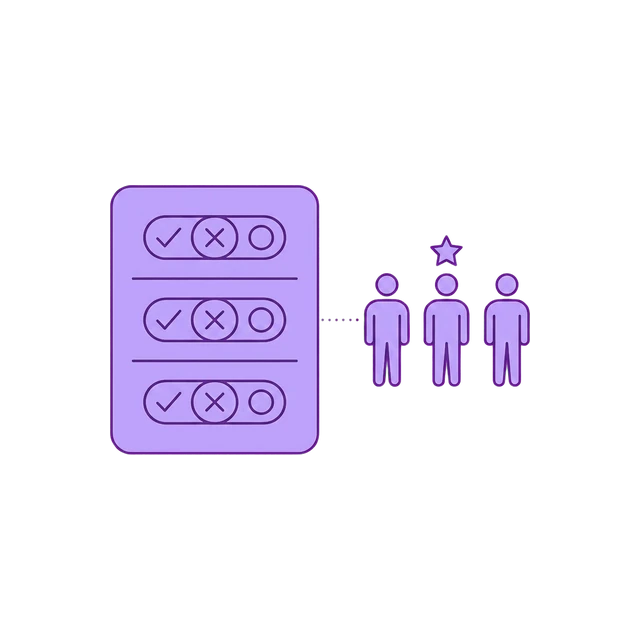
Find your DRep is a short quiz built entirely from completed on-chain votes. You answer a set of governance questions, and DRepTalk shows you a ranked list of DReps whose past votes align with your answers, each with a link to their written rationale where one exists. This guide explains exactly how that quiz is built and scored, so you can judge how much weight to put on the result.
Your answers never leave your device
Matching runs entirely in your browser. Your answers never leave your device. DRepTalk’s server never receives them, and there is nothing to opt out of because nothing is sent in the first place.
If you share a result link, the answers travel in the URL fragment, the part
after the # character. Browsers never send that part of a URL to a server,
so the fragment only ever reaches whoever you hand the link to directly.
Sharing a result link is a deliberate choice: the link itself contains your
answers, so only share it with people you are fine seeing them.
How questions are selected
The question pool starts from the 100 most recently completed governance actions that received at least one DRep vote. Completed means voting has ended, whether the action was ratified, enacted, dropped, expired, or closed. Actions still in their voting window are never used, since their outcome and vote counts are not final yet.
From that pool, an action qualifies as a question only if all of the following hold:
- It has a title.
- It received at least 50 combined Yes and No votes from DReps, counted per DRep rather than by voting power, so one large DRep cannot inflate the count on their own.
- Fewer than 60 percent of its DRep votes were Abstain. An action where almost everyone abstained does not separate DReps from each other, so it makes a poor question.
Where a DRep changed their vote on-chain, only their latest vote counts, both when selecting questions and later when matching.
Each qualifying action gets a score that reflects how evenly its Yes and No votes were split. Take the difference between the number of Yes votes and the number of No votes, divide that by the total number of Yes and No votes, and subtract the result from one. A perfectly even split scores highest, and a lopsided vote scores lowest. The closer the split, the better the question separates DReps who agree from DReps who do not.
Questions are ordered by that score, from most evenly split to least. Ties go to the newer action. To keep the set varied, at most 4 questions may share the same governance action type. Up to 10 questions make the final set. If fewer than 5 qualifying actions are available, the quiz shows a not-enough-data notice instead of a short quiz.
Which DReps can appear in results
A DRep shows up in your results only if all of the following are true:
- They are currently registered and active.
- Their on-chain metadata includes a public name.
- They have not set the “do not list” flag on their profile.
- Their voting power is between 25,000 and 50 million ada.
- They voted on at least two thirds of the selected questions, which is 7 out of 10 when the full set is used.
The 50 million ada cap is deliberate. The largest DReps already have outsized influence and plenty of visibility. Find your DRep is meant to surface the long tail of smaller DReps whose views you might otherwise never come across, not to point you toward whoever already holds the most power.
The 25,000 ada floor is the counterpart at the other end. Smaller voting power ranks first when two DReps tie, so without a floor a DRep with next to no stake behind them could top the list. The floor keeps the ranking to DReps that at least some delegators already trust.
How the match score is computed
Your score with a given DRep is based only on the questions you both answered. For each shared question:
- You and the DRep took the identical position: 1 point.
- One of you voted Abstain while the other took a firm Yes or No position: half a point.
- One of you voted Yes and the other voted No: 0 points.
Your match percent with a DRep is the total points divided by the number of shared questions. Questions you skipped, and questions the DRep did not vote on at all, are excluded from that count entirely, they neither help nor hurt the score.
Each result card prints that division underneath the percent, so 7.5 / 10 reads as seven and a half points across ten shared questions. Because the denominator is the shared count and not the full question set, two DReps can reach the same percent from a different number of shared questions: 7.5 out of 10 and 6 out of 8 are both 75 percent.
Two floors apply before a result appears:
- You must answer at least two thirds of the questions, 7 out of 10, to get a result at all.
- A DRep must share at least 5 answered questions with you to be ranked, on the full set of 10. The floor scales with the set size: two thirds of the set, rounded up, minus two, and never below two. A DRep who voted on very few of the questions you answered is excluded, since too small a shared set makes the percentage unreliable.
When DReps tie on match percent, the one with more shared questions ranks higher, since their score rests on more evidence. If they are still tied, the DRep with smaller voting power ranks higher, consistent with the same long-tail goal behind the 50 million ada cap.
What the score is not
A match percent measures past voting alignment only. It is not a prediction of how a DRep will vote in the future, and it is not an endorsement by DRepTalk of any DRep. All the votes behind it are public on-chain data, the same votes anyone can look up directly on a DRep’s profile.